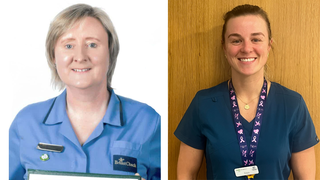
From helping women through assessment and diagnosis to supporting them during treatment and recovery, Breast Care nurses are at the heart of the BreastCheck journey. For International Nurses Day, Jacinta O’Reilly, BreastCheck Eccles Unit and Grace Walsh, BreastCheck Merrion Unit share what the role means to them and why supporting women through breast screening matters.
For Jacinta O’Reilly, supporting women through BreastCheck has been her life’s work for the past 25 years.
For Grace Walsh, who joined BreastCheck just over a year ago, the role already feels deeply meaningful.
Although they are at different stages of their careers, both Grace and Jacinta describe the same thing at the centre of their work: supporting women through one of the most difficult times in their lives with kindness and care.
“It's all about the woman and delivering the best care possible,” Jacinta says.
Supporting women through every step
Breast Care nurses support women who are recalled for assessment following a screening mammogram. They support them through assessment and results, and through diagnosis, treatment and follow-up care.
The work is busy and varied. They are there to answer questions, explain what happens next, provide reassurance and coordinate care. Their days can include assessment clinics, results clinics and multidisciplinary meetings where they plan the next steps for each woman, as well as visiting women in hospital.
Grace says: “Every day is different, but everything is centred on planning care for women – scans, follow-ups, surgery, wound reviews and visiting women post-surgery. It’s about making sure every woman gets the support she needs.”
Jacinta adds: “You’re there to guide women from the day they come into the assessment clinic, right through biopsies and diagnosis. In clinic, you could see 15 or 16 women – some getting good news, some needing more treatment, some newly diagnosed. We organise everything - treatment, supports, counselling - whatever they need.”
Grace says a big part of the role is helping women understand what is happening and reassuring them that support is always there.
“When someone is diagnosed, everything is put into perspective – it’s one of the hardest things they can be told,” she says.
“As nurses, we have the knowledge, and we use that to guide them and explain what’s ahead.”
Consistent care
Both Grace and Jacinta describe their role as being a steady, consistent, trusted point of contact for women throughout their care.
“We’re that point of contact for women,” Jacinta says. “They always have our number and can contact us at any stage to talk or ask questions.”
Grace agrees: “We never go home without returning calls – that continuity is really important. It’s about making the journey less difficult for women. Even just being a listening ear can make a difference.”
Better outcomes
While a breast cancer diagnosis can be frightening, both nurses are passionate about encouraging women to attend screening when invited.
“The whole purpose is to catch it early and improve outcomes for women,” Grace says. “It’s amazing that we can find a cancer before somebody even has a symptom. I know it can feel scary, but early detection gives you the best chance of a more successful outcome.”
Jacinta agrees and she also points to major advances in breast cancer care over the past 25 years.
“There have been huge improvements – in imaging, in surgery, and in how we care for women. Treatment is now very tailored to the individual,” she says. “We’re picking things up much earlier and at a much smaller size. Many women now avoid chemotherapy or have less treatment than before.”
Jacinta says reassuring women about outcomes is an important part of the role.
“It’s a very stressful time for women,” she says. “We reassure them that women who have breast cancer detected through screening do really well and that life will go back to normal.”
Moments that matter
For Jacinta, one of the most meaningful parts of the role is the connection with women – and some connections have lasted decades.
“I have women I looked after 25 years ago who still send Christmas cards or get in touch,” she says. “That means a lot.”
For Grace, it is the strength and resilience of women that stands out most.
“They are incredibly brave and resilient,” she says. “They show up, they keep going, and they still manage to bring positivity. That strength really stays with you.”
Proud to be part of BreastCheck
Both Grace and Jacinta say the women they meet, and the “fantastic colleagues” they work alongside, keep them motivated. They feel proud to work in BreastCheck and to support women through their care.
For Grace, working as a Breast Care nurse felt like the right fit from the beginning. She had worked as a general nurse and specialist nurse caring for mainly head and neck cancer patients.
“I always knew I wanted to work in oncology,” she says. “When I was looking for a change, breast care just felt right. Working in BreastCheck is so rewarding. I honestly haven’t looked back.”
And after 25 years, Jacinta’s view is just as clear.
“It’s ever changing, and it’s always for the better of the patient,” Jacinta says. “That’s why you’re proud to work in it. You know women are getting the best possible care. I’d be proud for any friend or family member to come through BreastCheck.”