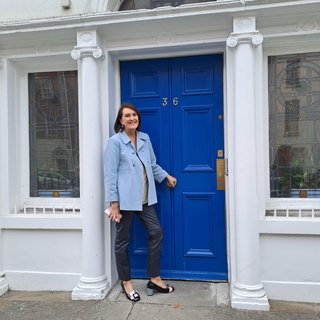
"We had a belief that breast screening should happen in this country, and we made it so,” says Prof Fidelma Flanagan of the advent of breast screening in Ireland, a quarter of a century ago.
The National Clinical Advisor of BreastCheck has been with the national breast screening programme since it was first piloted back in the 1990s. Now, as she prepares to retire from the service, she recalls her 25-year journey of caring for women through BreastCheck.
Bringing screening to Ireland, she says, was “not easy”. Yet breast screening was already well established elsewhere. The UK and Northern Ireland had been offering women breast screening for 10 years before the pilot in Ireland.
As with many seismic changes in Irish society over the years, the arrival of the BreastCheck programme was heralded on the Late Late Show, in 1997. “Prof Joe Ennis, a former colleague of mine in the Mater Hospital, launched the pilot programme on the show.”
The pilot initiative was sponsored by the European Reference Organisation for Quality Assured Breast Screening and Diagnostic Services (EUREF) and consisted of two screening sites in Dublin and Monaghan. As the respective constituencies of the then taoiseach Bertie Ahern and health minister Dr Rory O Hanlon, Flanagan says the location choice was “entirely predictable”.
However, as a radiology registrar working in the Mater Misericordia University Hospital set within Ahern’s constituency, Monaghan-born Flanagan reflects that “the writing was on the wall for me becoming involved in breast screening”.
“The Dublin site was housed in one of the Mater Hospital’s Georgian buildings on Eccles Street; it offered sanctitude from the cut and thrust of the hospital and provided me with ample opportunities for research and publications,” she says.
The pilot programme proved successful and BreastCheck, the National Breast Screening Programme, became a reality in 2000. Flanagan was appointed alongside Prof Ann O’Doherty as a Clinical Director working to establish the screening programme in the east of the country.
“My first day as Clinical Director of the Eccles unit was quite daunting. We had no premises, staff, or equipment but, bit by bit, we built it. The Irish diaspora responded and many consultants and staff - both clinical and management - came from far and wide. Indeed, they continue to come,” she says, acknowledging the fact that the programme continues to attract staff from overseas today.
“The Eccles Unit or the ‘Old Mater Private’ as it was then, had lain derelict for over 10 years, the hospital not having the 10,000 punts needed to secure its demolition. Thankfully this lovely building was rescued by BreastCheck and is now one of our four static units which deliver screening around the country.”
Two further static units - in Cork and in Galway - were set up in 2007. Clinical Directors were appointed to each unit to aid the national expansion. Today the service is operated by the HSE’s National Screening Service and includes 280 staff nationwide. “The Clinical Directors are great advocates for the population they serve, and for the unit staff,” Flanagan says.
It is a principal of the programme that it offers screening services locally to women in counties and locations convenient to where they live. To achieve this, each of our four static screening units operate in tandem with 24 mobile units. Most women participating in BreastCheck have their mammogram in one of these mobile units.
Over 2.5 million BreastCheck mammograms have been performed during Flanagan’s time with the service, and over 16,000 cancers detected. One in 7 women will be diagnosed with breast cancer in their lifetime, and breast screening aims to find cancer at an early stage, before a woman has any symptoms.
On average there are about 3,365 cases of breast cancer diagnosed in Ireland each year and BreastCheck can detect about one third of all these cases.
In 2022 the National Cancer Registry published the national trends for cancers with population-based screening programmes in Ireland 1994-2019. The report showed the proportion of women diagnosed with early-stage cancers was higher in the screened age group; significant decreases in mortality rates by an average 1.8% per year; and a 2% year-on-year improvement in survival in our screening cohort – a figure that compares well internationally.
“BreastCheck punches way above its weight internationally. We have contributed to the training of generations of doctors specialising in breast health, and the training of allied health professionals across all disciplines. We have hosted international conferences and published medical and scientific papers that are a valuable contribution to screening literature. We have been accredited by European experts as an exemplar screening programme.”
“We have a robust and high-quality service,” says Flanagan, who cites “collaboration, listening, partnership and respect” as being the key to achieving and maintaining quality in a busy service.
A key partnership, she says, is with the women themselves. “Women who often come to the breast screening units feeling a level of anxiety and they place their trust in us. In those daily interactions, despite the nature of the work and the dreadful disease we are working to diagnose and treat, we are met with warmth, curiosity, humour and understanding every day. It truly is a partnership approach to healthcare.”
Future direction
Flanagan is hopeful, too, about what breast screening will offer women in the future. “I can’t believe how far we have come in 25 years, the next 25 will be even better,” she says. She points to the evidence review being evaluated by the National Screening Advisory Committee to lower the age range of breast screening to women aged 45. “Should we screen more women with the same tools, evolving with the knowledge we gain year on year? Or will the future be more revolutionary – will screening be a different test or will we be risk assessing people in a different way? Should we be doing personalised screening? Should our service be supported by AI and MRI? Whatever the future direction of screening, I have full confidence in BreastCheck to continue to deliver an excellent, caring and meaningful service, saving lives and improving the health of our population.”