
Levels of knowledge about the benefits and limitations of cancer screening were mixed among the general public in our 2021 national online survey. The findings of the survey among 2,000 participants aged 18+ were presented by our Research Officer, Dr Mairead O’Connor, at the recent International Cancer Screening Network Conference in Turin (21-23 June 2023).
The overall aim of the research was to identify and explore peoples’ perceptions of cancer screening services in Ireland and what drives and inhibits people to attend screening.
48% of the survey participants were males and 52% were females. Of the 2,000 participants, 348 were eligible for breast screening, 782 people were eligible for cervical screening and 320 were eligible for bowel screening.
So what is the public’s understanding of cancer screening?
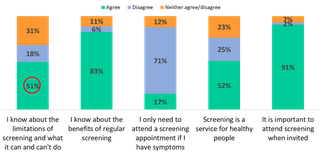
83% of respondents agreed that they knew about the benefits of regular screening, while just over half (51%) of respondents felt they knew about the limitations of screening and what it can and can’t do. 52% of respondents agreed that screening is a service for healthy people.
Breast screening
Among those eligible for breast screening, 45% named early detection as a benefit while 19% named detection of abnormalities or changes in the breast as a benefit. Two thirds (66%) could not name any limitations of breast screening.
Cervical screening
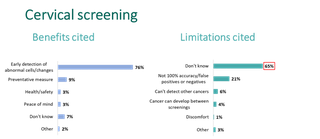
In those eligible for cervical screening, over three quarters (76%) named early detection of abnormal cells as a benefit. A majority of respondents (65%) could not name any limitations of cervical screening.
Bowel screening
Among participants eligible for bowel screening, 55% named early detection of abnormalities as a benefit of bowel screening. 12% did not know any benefits of bowel screening. Three-quarters (75%) did not know any limitations of bowel screening.
A higher proportion (75%) of those eligible for bowel screening could not name any limitations compared to 65% of those eligible for cervical screening and 66% for breast screening.
12% of those eligible for bowel screening could not name any benefits of bowel screening compared to 7% for cervical screening and 8% for breast screening.
Conclusion
The results from the survey highlight the challenges around striking a balance between the benefits and limitations of screening when communicating with the public. We will use the findings to improve this to enable people to make informed and individual choices about participating in screening.
The survey was conducted on behalf of the National Screening Service by Core Research.